

Airbnb Welcome Book: A Complete Template for Hosts in Croatia
BookiApp Tim
Vacation Rental Guest App
Key takeaway
An Airbnb Welcome Book is a key tool that centralizes all property and local information, reducing repetitive guest questions by up to 70%. This guide provides a free template with 15 essential sections, including WiFi, parking, and house rules, and covers Croatian specifics like eVisitor registration and tourist tax. Implementing both digital and print versions optimizes communication and significantly improves reviews.
Key points
- 1Reduce Inquiries: A well-structured Welcome Book can eliminate up to 70% of common guest questions.
- 2Croatian Specifics: Be sure to include sections on eVisitor registration, the tourist tax (boravišna pristojba), and local customs.
- 3Hybrid Approach: The best strategy is to combine a digital guide (sent before arrival) with a physical copy in the apartment.
- 4Key Sections: WiFi, parking, trash disposal, and air conditioner instructions are the four most frequently requested pieces of information.
Table of contents
A guest asking for the WiFi password at 11 PM. A message about where to dispose of trash while you're at the beach. A call because they can't turn on the air conditioning. These scenarios define the daily reality for hosts during the high season.
While they may seem like minor interruptions, they cumulatively consume hours and create operational chaos. The solution is proactive communication, and its most powerful tool is the Welcome Book.
This document isn't just a nice touch; it's a strategic tool that, according to industry data, can reduce the number of repetitive guest questions by an impressive 70%. This means less stress for the host and a more independent, satisfied guest.
— 01What Is a Welcome Book and Why Does It Reduce Questions by 70%
A Welcome Book is a curated guide for guests that centralizes all essential information about the rental unit and the local area. Its primary function is to proactively answer 9 out of 10 common questions before the guest even asks them. This drastically reduces the need for reactive communication and frees up the host's time for more important tasks.
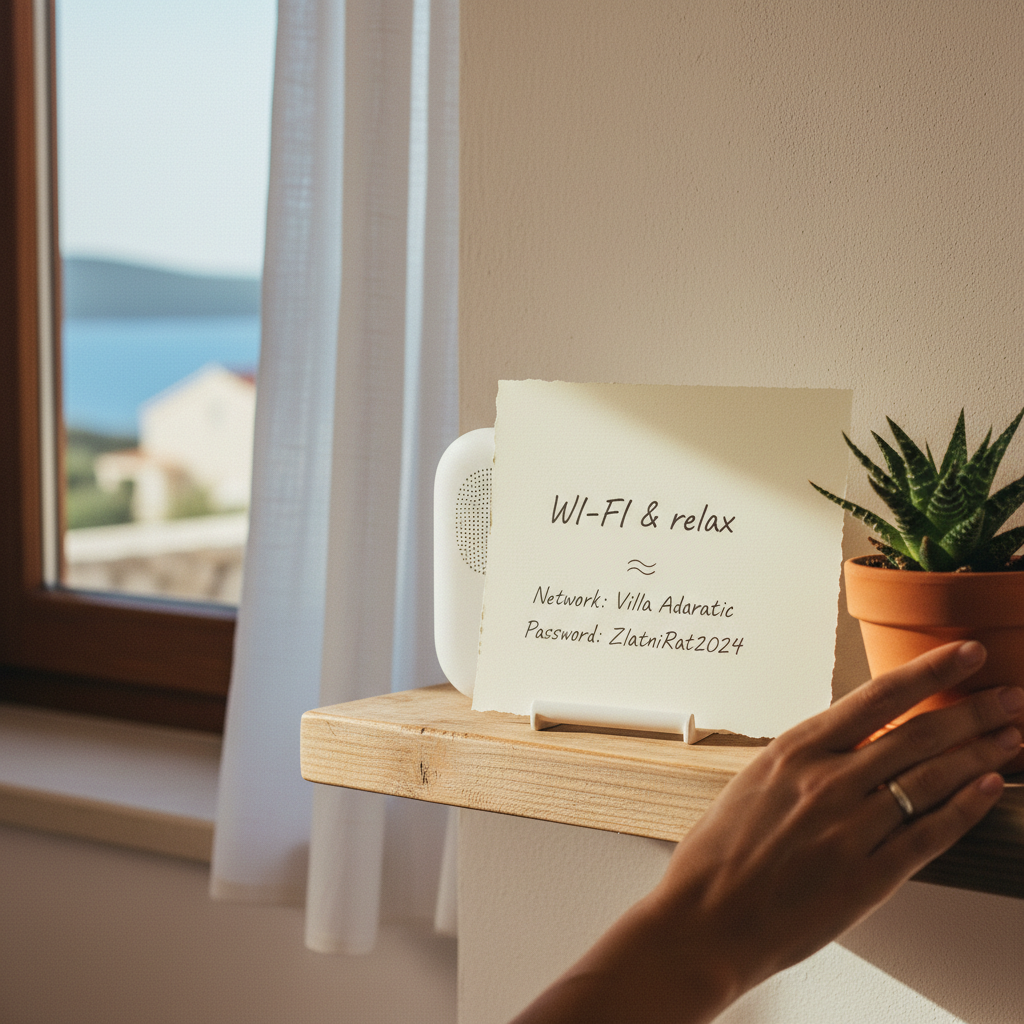
The psychology behind the Welcome Book's success is simple: guests feel more secure and independent when information is readily available. Instead of waiting for a reply to a message, they can find a solution immediately, which directly impacts their overall experience and, consequently, their final review.
70%
Fewer repetitive questions
0.5★
Potential rating increase for communication
90%
Coverage of the most common inquiries
A quality Welcome Book transforms the guest experience from a series of questions and answers into a seamless, self-sufficient stay. It's the difference between an amateur and a professional approach to hosting.
— 0215 Essential Sections for Every Welcome Book (Template)
A comprehensive Welcome Book must contain 15 key sections covering everything from critical access information to specific instructions for using appliances. This structure ensures guests have all the necessary information in one place, logically organized for quick reference. Skipping any of these points will almost certainly result in additional messages and calls.
Here is a complete list of sections that form the foundation of any professional Welcome Book:
- 1 A Heartfelt Welcome: A short, personalized message. No longer than 2-3 sentences. Example: "Dear {Guest Name}, welcome to {Apartment Name}! We hope you enjoy your stay in {City}. We're here for any questions you may have."
- 2 Contact Information: Your phone number (WhatsApp/Viber), email, and an emergency contact (e.g., a co-host or neighbor).
- 3 WiFi Details: Clearly display the network name (SSID) and password. This is the most requested piece of information.
- 4 Check-in and Check-out Procedures: Exact times (e.g., Check-in from 3:00 PM, Check-out by 10:00 AM), instructions for keys or a self-check-in code, and the departure procedure (e.g., "Please leave the keys on the table and close the door behind you.").
- 5 Parking: Precise instructions. If parking is private, include a picture or map of the parking spot. If it's public, state the prices (e.g., Zone 2, price 1.50 EUR/hour) and options for free parking nearby.
- 6 Trash Disposal: Location of the bins, collection schedule, and recycling rules (plastic, glass, paper). A photo of the bins can be extremely helpful.
- 7 Appliance Instructions: Short, clear instructions for using the air conditioner, TV (including streaming services like Netflix), dishwasher, washing machine, coffee maker, etc.
- 8 House Rules: A concise summary of rules. Focus on key points: no smoking, no pets, no parties, and respecting quiet hours (e.g., from 2-5 PM and after 10 PM).
- 9 Emergencies: The universal emergency number (112) and numbers for the police (192), fire department (193), and ambulance (194). Also, list the property's address for easy reference.
- 10Local Transportation: Information on the nearest bus stop, local taxi numbers, ride-sharing apps (Uber, Bolt), and links to ferry schedules (Jadrolinija) if applicable (e.g., for Hvar or Brač).
- 11Local Recommendations: This is your chance to shine. Recommend 3-5 restaurants (of varying price ranges), cafes, beaches, sights, and activities that aren't in every tourist guide.
- 12Nearest Grocery Store, Bakery, and Pharmacy: List their names, addresses, and opening hours.
- 13Security Information: Instructions for locking doors and windows, and using the safe (if available).
- 14Air Conditioning and Heating: More detailed instructions with a photo of the remote control, explaining key functions (cooling, heating, dehumidifying).
- 15Hot Water: Information about the water heater, whether it needs to be turned on, and how long to wait for hot water. Example: "The water heater in the bathroom is always on. It has a capacity of 80 liters."
BookiApp Data
Based on an analysis of 200+ hosts in the BookiApp database, inquiries about the WiFi password, parking, and trash disposal make up over 50% of all guest messages on arrival day.
— 03Croatian Specifics: eVisitor, Tourist Tax, and Local Customs
For properties in Croatia, a Welcome Book must include information required by law and specific to the local culture. These sections demonstrate professionalism, build trust, and help guests navigate the legal and cultural environment. This includes explaining the eVisitor registration process, providing information on the tourist tax, and offering tips on local customs.
1. eVisitor Registration
According to the Croatian Hospitality and Catering Industry Act, every guest must be registered in the eVisitor system within 24 hours of arrival [1]. Guests are often unaware of this rule and may be suspicious when you ask for their personal documents.
- What to write: "According to Croatian law, we are required to register every guest's stay in the national tourist information system, eVisitor. For this reason, we will need to photograph or scan your ID cards or passports upon your arrival. Your data is used exclusively for this purpose." This simple explanation removes any awkwardness.
2. Tourist Tax (Boravišna pristojba)
Although the tourist tax is usually included in the nightly rate on platforms like Booking.com and Airbnb, it's helpful to mention this to avoid misunderstandings. The price varies by location and season, ranging from 1.50 to 2.00 EUR per person per day.
- What to write: "The tourist tax (boravišna pristojba) is included in the price of your stay, in accordance with local regulations. You do not need to worry about any additional payments on this basis."
3. Local Customs and Culture
This section adds value and helps guests feel like locals. Include practical tips:
- Afternoon Rest (Fjaka): In Dalmatia, the period between 2:00 PM and 5:00 PM is often a time for rest. Explain that it's customary to reduce noise in residential buildings during these hours.
- Payment: While cards are accepted in most restaurants and shops, cash is still king at local markets, bakeries, and some cafes in smaller towns. Advise guests to always have some euros on hand.
- Tap Water: Emphasize that tap water throughout Croatia is safe and of high quality to drink.
- Marenda: Explain the concept of 'marenda' – an earlier, lighter lunch between 10:00 AM and 12:00 PM, which is why many restaurants have special daily offers at that time.
— 04Digital vs. Print Welcome Books: What to Use and When
The choice between a digital and a print Welcome Book depends on guest demographics and property logistics. Digital guides, created with tools like Hostfully or Touch Stay, are ideal for sending to guests before arrival, while a durable, printed version is indispensable inside the property for quick access to information. The most successful hosts use a hybrid approach.
Digital versions allow for interactivity—links to Google Maps, timetables, or restaurant menus. Tools like Hostfully Guidebooks cost from $7.99 USD per month and offer professional templates. A free alternative is to create a visually appealing PDF in a tool like Canva and send it via WhatsApp or email.
A printed copy, on the other hand, doesn't depend on a battery or an internet connection. It must be easy to read, durable (ideally laminated), and placed in a visible spot like the living room coffee table.
| Feature | Digital Welcome Book | Print Welcome Book |
|---|---|---|
| Availability | Before, during, and after the stay | Only during the stay |
| Updates | Easy and instantaneous | Requires re-printing |
| Interactivity | High (links, maps) | Low |
| Cost | Monthly subscription or free PDF | One-time printing cost |
| Reliability | Depends on WiFi and device | Always available |
| Best For | Sending 3 days before check-in | Leaving on the table in the apartment |
The best strategy isn't choosing between digital and print, but combining them: digital for planning, print for in-the-moment use.
For example, for an apartment in the old town of Split where parking is a challenge, a digital guide sent in advance can include a Google Maps link to the nearest public garage, "Stari Pazar." Meanwhile, the printed version in the apartment can have a simple, hand-drawn map showing the walking path from the garage to the apartment. This combination solves the problem on multiple levels and shows exceptional care for the guest.
Ultimately, a Welcome Book is not an expense, but an investment. The time invested in its creation pays off manifold through saved time, reduced stress, better reviews, and happier guests who are likely to return. It is the foundation of a professional and scalable business in the short-term rental sector.
Sources
Frequently asked questions
1Should I translate my Welcome Book into multiple languages?
Yes, it's highly recommended. At a minimum, translate it into English. If you frequently host guests from a specific language group (e.g., Germany, Italy), a translation into their language is an excellent touch they will appreciate. Use professional translation tools or services for accuracy.
2How long should a Welcome Book be?
The ideal length is between 5 and 10 pages (A4 format). The goal is not to write a novel but to provide concise and easily digestible information. Use plenty of headings, bullet points, and images to make it scannable and user-friendly.
3What is the biggest mistake hosts make with their Welcome Book?
The biggest mistake is creating it once and never updating it. Information changes—restaurants close, schedules are modified, the WiFi password gets updated. Review and update your Welcome Book at least once a year, ideally before the start of each season.
4Can I just use a QR code instead of a full Welcome Book?
Yes, a QR code is an excellent way to bridge the print and digital worlds. In your printed guide, you can include a QR code that links to the full digital version with interactive maps and links. It's an elegant solution that offers the best of both approaches.
BookiApp Tim
Vacation Rental Guest App
The BookiApp Team combines hands-on hosting experience with market data insights. We write practical guides for small-scale hosts of apartments, villas, and rooms—no fluff, just actionable numbers and verified sources.
Related articles

Vacation Rental Insurance: What Airbnb and Booking Don't Cover (2026)
Think Airbnb AirCover or Booking.com's insurance has you covered? Discover what these platforms miss, from guest liability to property damage, and what policy you actually need.
Read more
How to Get Guests to Book Direct and Save 18% on Commissions
A guide for vacation rental hosts in Croatia: Learn how to legally encourage guests to book direct, avoid Booking.com's 15-18% commission, and build a loyal guest base.
Read more