
Eco-Friendly Rentals: What Guests Want (and What Is Greenwashing)
BookiApp Tim
Guest Experience App
Key takeaway
Sustainability in tourism is no longer a luxury option, but a basic standard dictated by the market. Guests in 2026 easily spot greenwashing and demand concrete actions rather than empty promises. Waste separation has become the absolute minimum, while solar panels yield an ROI only after 6 to 8 years. The most crucial step for property owners is eliminating single-use plastics and relying on verified certificates.
Key points
- 1Minimum standards: Recycling bins with clear labels are a basic expectation today, not a premium add-on.
- 2Solar profitability: An investment of 5,000 to 8,000 EUR pays off mainly for properties that operate for most of the year (e.g. May to October).
- 3Local landscaping: Using Mediterranean plants saves hundreds of liters of water weekly compared to thirsty tropical species.
- 4The end of single-use plastic: Switching to large shampoo dispensers (500 ml) is the fastest way to eliminate the greenwashing label.
Table of contents
Sustainability in 2026 has become one of the main search filters on platforms like Booking.com and Airbnb. Modern travelers are highly sensitive to environmental issues and easily spot the difference between genuine effort and a mere marketing trick. If an apartment promotes ecology but offers cellophane-wrapped plastic cups in the bathroom, guests will immediately recognize it as greenwashing.
Trends show that the profile of the average guest in Croatia is changing. Tourists from Germany, Austria, and Scandinavia come from cultures where environmental awareness is highly developed. For them, sustainability is not a compromise on comfort, but an indicator of the host's professionalism and the quality of the accommodation itself.
Through an analysis of market standards, it is clear which eco-friendly practices deliver real results and positive reviews. Here is an overview of the key elements of eco-friendly renting that make a tangible difference.
— 01Recycling Bins: The Minimum Every Guest Expects
A recycling stand for waste separation is no longer a luxury, but a basic standard that most guests now expect in an apartment. If your accommodation lacks clearly marked bins for paper, plastic, and mixed waste, guests will often highlight this as a negative in reviews. Tourists are used to separating waste at home and get frustrated when they cannot do so on vacation.
Implementing this solution requires minimal investment and guests notice it as a sign of quality. A high-quality set of waste separation bins costs between 30 and 60 EUR. The key is to provide clear, visual instructions in multiple languages above the bins themselves.
For maximum efficiency and to avoid confusion, instructions must cover 3 basic rules:
- Bin colors must match the colors of the local utility company (yellow for plastic, blue for paper).
- Visual examples should clearly show what goes into which bin (e.g., a picture of an empty water bottle for plastic).
- Container locations on the street must be clearly explained in the house rules or digital guidebook.
In destinations like the island of Krk or Split, where waste separation rules are strict, educating the guest prevents potential municipal fines for the property owner.
— 02Solar Panels on Apartments: When the Investment Pays Off
Installing solar panels pays off for property owners in Dalmatia and on the islands, with an approximate return on investment (ROI) of 6 to 8 years. For properties operating exclusively for two months in the summer, this 5,000 to 8,000 EUR investment rarely makes financial sense without government incentives. On the other hand, holiday homes with heated pools operating from May to October can cut their electricity bills considerably.
5,000–8,000 EUR
approximate cost of a small solar power plant
6-8 years
approximate payback period in Dalmatia
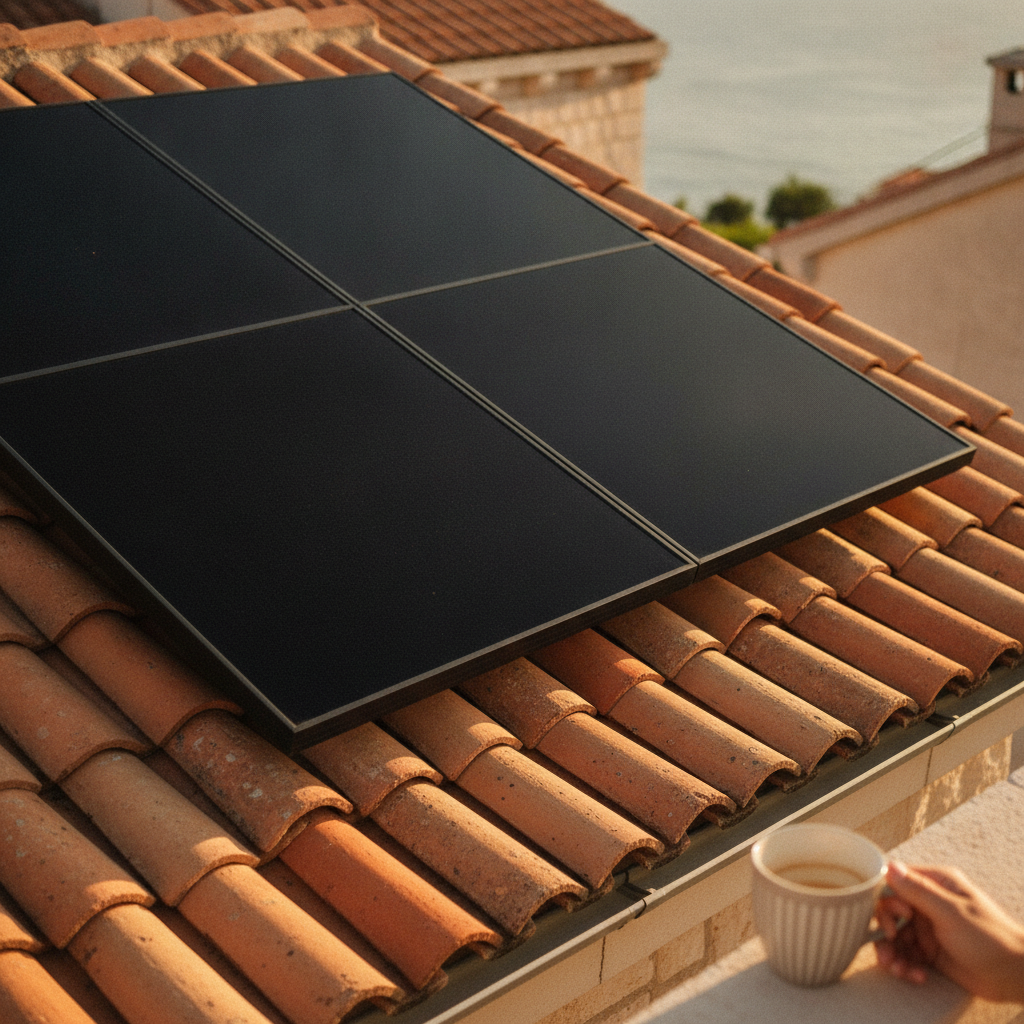
When planning an installation, property owners must consider the actual consumption of their guests. An average 60 m² apartment in Hvar or Dubrovnik consumes significant amounts of energy for air conditioning during July and August. A 3 to 5 kW solar system generally covers these peak summer needs.
The Croatian Environmental Protection and Energy Efficiency Fund (FZOEU) periodically opens public calls co-financing rooftop solar plants on family homes, and some towns and municipalities run similar calls. The share covered, deadlines and conditions change from call to call — before investing, check on fzoeu.hr and with your town or municipality whether a property where you provide tourist accommodation is eligible [1].
— 03Tropical Plants vs. Local Plants: What Is Truly Eco-Friendly
Genuine ecological landscaping involves using native Mediterranean plants that require minimal watering, rather than thirsty tropical species. Although palms and exotic flowers look attractive in photos, maintaining them during dry summer months consumes hundreds of liters of drinking water per week. Guests increasingly recognize this waste of resources as a classic example of greenwashing.
Local species like lavender, rosemary, olives, and immortelle not only save water but also create an authentic destination experience. Authenticity in 2026 is a highly valued currency on rental platforms.
A true eco-friendly accommodation does not try to replicate Bali in Dalmatia, but celebrates the resilience and beauty of the local Mediterranean landscape.
Smart garden planning also includes installing a drip irrigation system connected to a timer. Such a system further reduces water consumption and ensures plants receive exactly the amount of moisture they need, at the right time of day.
— 04Single-Use Plastics in Accommodation: What to Eliminate Urgently
Eliminating single-use plastic shampoo bottles, straws, and cups is the fastest way to achieve authentic eco-status without major investments. Guests in 2026 consider the practice of leaving mini-cosmetics outdated and unecological. Instead, they prefer large wall-mounted dispensers (500 ml) filled with high-quality, preferably local products.
Replacing small plastics brings direct financial savings. Buying cosmetics in 5-liter bulk packaging and refilling dispensers usually cuts the annual cost of hygiene supplies noticeably.
Here are 4 key items that should be immediately replaced with eco-friendly alternatives:
- Mini shampoos and gels — replace them with elegant wall-mounted dispensers in the shower.
- Plastic trash bags — use biodegradable bags for organic waste.
- Plastic cups in the bathroom — provide washable glass cups.
- Coffee machine capsules — offer compostable capsules or switch to a classic espresso machine.
— 05Eco-Certificates for Apartments: Which Labels Guests Actually Check
Guests place the most trust in official international labels like the EU Ecolabel certificate, while generally ignoring internal and unverified "green" badges. The certification process requires effort, but it serves as undeniable proof that the apartment truly meets strict environmental standards.
Obtaining the EU Ecolabel involves meeting a series of criteria, from energy efficiency to waste reduction [2]. The criteria for tourist accommodation are set at EU level, and compliance is checked by the competent body in each member state — which is what makes the label credible.
BookiApp Data
If you hold an official certificate, show it in your listing description and in your digital guest guidebook — guests then see straight away that an independent third party stands behind your eco message.
It is worth knowing that in 2023 Booking.com dropped its former sustainability badge (Travel Sustainable) and since then specifically highlights properties certified by a recognized third party. Simply stating that you do not use plastic is no longer enough for such a label. Investing in proper certification protects your property's market reputation in the long run.
Frequently asked questions
1Do I need to provide a compost bin in the apartment?
No, composting inside the apartment carries the risk of unpleasant odors and attracting insects, which bothers guests. It is enough to provide biodegradable bags and direct guests to the local bio-waste container.
2How much does it cost to introduce large soap and shampoo dispensers?
The initial cost of high-quality wall-mounted dispensers is around 30 to 50 EUR per bathroom. In the long run, buying cosmetics in 5-liter packages is usually noticeably cheaper than mini-plastics.
3Which eco-certificate is best for private vacation rentals in Croatia?
The EU Ecolabel is the most recognized and transparent certificate at the European Union level. Guests from Germany and Scandinavia recognize this label and trust its strict criteria.
4Can I charge a higher price if I have an eco-friendly apartment?
It is possible — some guests are willing to pay a somewhat higher price for accommodation that demonstrably cares for the environment, especially if it holds an official certificate and offers premium natural cosmetics.
BookiApp Tim
Guest Experience App
The BookiApp Team combines active hosting experience with analytical market insights. We write practical guides for owners of apartments, villas, and rooms in Croatia—free of fluff, packed with concrete numbers, and backed by verified sources.
Related articles
Guest No-Shows: A Guide to Charging and Reporting in 2026
Learn how to securely charge a no-show reservation, handle Booking.com communication, and manage eVisitor reporting without penalties in 2026.
Read more
How Many Languages Must a Vacation Rental Host Know in 2026?
Discover how many languages vacation rental hosts in Croatia actually need to know in 2026. Explore English, German, AI tools, and WhatsApp translation tricks.
Read more