

Hyperlocal Marketing: How to Become the Go-To Guide for Your Island or Town
BookiApp Tim
Vacation Rental Guest App
Key takeaway
Hyperlocal marketing is a strategy of creating ultra-specific content (guides, recommendations) for your micro-location. Instead of general topics, you focus on answering concrete questions your guests are Googling, like 'best fish restaurant in Komiža.' This approach builds trust and authority, leading to better Google rankings for specific queries and, most importantly, attracting guests who want to book directly, bypassing OTA commissions that often start at 15% but can exceed 20% for high-visibility programs.
Key points
- 1Specificity ranks: For queries like 'best beaches for families with children near Trogir,' Google prefers your detailed blog post over a generic 'Top 10 Croatia' article.
- 2Long-tail keywords: Phrases like 'rent a boat without a skipper Vis archipelago' have lower search volume but up to a 3x higher conversion rate into a direct inquiry.
- 3Local partnerships: An agreement with a local winery for a 10% discount for your guests creates a unique offer and authentic content for your website.
- 4Measure success: Track inquiries from your website's contact form versus those from Booking.com. A realistic goal is to reach 20-30% direct bookings within two seasons.
- 5Authenticity over production: A mobile phone photo of a dish at a recommended restaurant often generates more trust and engagement than a professional stock photo.
Table of contents
Guests searching for vacation rentals in 2026 aren't just looking for a bed. They're looking for an experience. And they're searching for answers about that experience on Google long before they even open Booking.com or Airbnb.
This is precisely where the opportunity lies for hosts who want to reduce their dependence on major platforms and their commissions. The strategy is called hyperlocal marketing—turning your knowledge of your own town or island into content that attracts ideal guests and encourages them to book directly.
This isn't just a passing trend; it's a fundamental shift in how SEO will function in the tourism industry. Becoming a local digital authority means ensuring the long-term sustainability of your business.
— 01What Is Hyperlocal Content and Why Does It Beat Generic Guides?
Hyperlocal content is ultra-specific content created for your micro-location—a neighborhood in Split, a bay on Hvar, or a street in Rovinj—that answers very specific questions tourists ask. Instead of a generic "Best beaches in Croatia," a hyperlocal approach focuses on "Hidden beaches on the south side of Hvar accessible by car." This builds authority, ranks better for specific queries, and attracts guests seeking an authentic experience.
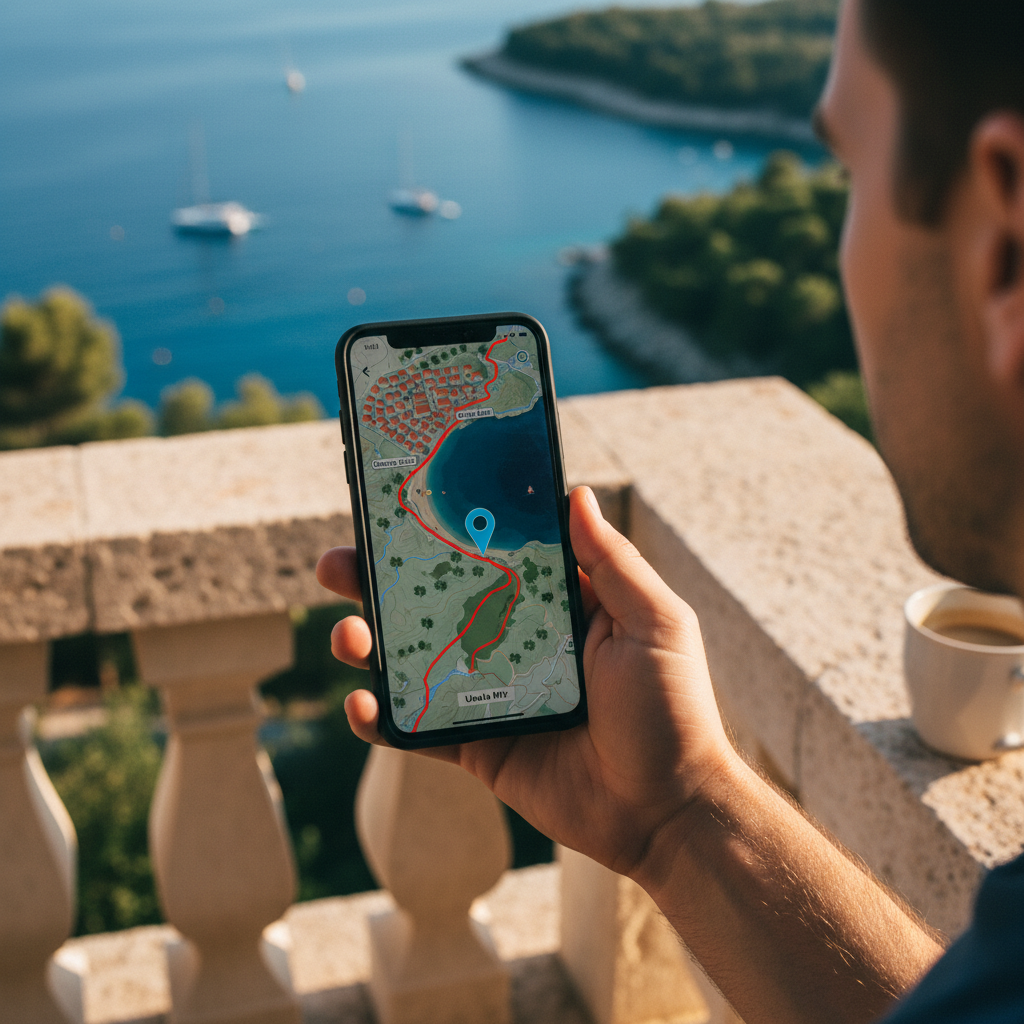
The difference in approach is key. Large portals compete for broad terms with huge search volumes but low conversion rates. A small rental owner cannot compete for the term "apartments Croatia." But they can certainly become the number one result for "apartment in Trogir with a view of Kamerlengo Fortress."
According to tourism industry data, over 70% of travelers research activities and restaurants before booking their accommodation. Your blog can be the first point of contact with a potential guest. If you provide them with valuable information, you build trust that can easily convert into a direct booking.
BookiApp Data
Based on an analysis of over 200 hosts in the BookiApp database, those with an active blog featuring at least 5 local guides receive an average of 15% more direct inquiries compared to those who rely solely on OTA platforms.
— 02How to Create a Guide Google Loves: Long-Tail Keywords in Action
A guide that ranks high on Google focuses on "long-tail" keywords. These are longer, more specific phrases with lower search volume but extremely high user intent. Instead of targeting a broad term like "Hvar restaurants," you target a phrase like "romantic dinner restaurant in Hvar with a view of the Pakleni Islands." Such queries bring qualified visitors who are already in the planning phase and closer to a booking decision.
How do you find these keywords?
- Google Autocomplete: Start typing a query into Google and see what suggestions it offers.
- "People Also Ask" Section: This section in the search results directly gives you the questions people are asking.
- Listen to your guests: What questions do they most frequently ask upon arrival? Each of these questions is a potential title for your blog post.
| Broad Term (Hard to Rank For) | Long-Tail Keyword (Easy to Rank For) |
|---|---|
| Split excursions | One-day boat trip from Split to the Blue Lagoon |
| Brač beaches | Best sandy beaches on Brač for small children |
| Dubrovnik restaurants | Affordable restaurants within Dubrovnik's city walls |
Once you've defined a topic, structure the article to answer all potential questions. Use subheadings (H2, H3) that contain keywords. For example, an article about beaches might have subheadings like "Beaches with Natural Shade," "Beaches with Parking," and "Dog-Friendly Beaches."
— 03Local Business Partnerships: Content That Writes Itself
Strategic partnerships with local businesses are the foundation of successful hyperlocal marketing. Collaborating with wineries, restaurants, tour agencies, or small family farms (OPGs) allows you to offer guests exclusive perks. This could be a 10% discount on dinner, a free wine tasting, or priority booking for a boat trip. These benefits become a powerful incentive for guests to book directly through your website.

Such partnerships have a dual benefit:
- 1 They create unique value for the guest: You're offering something they can't get by booking through Booking.com.
- 2 They generate authentic content: An interview with a local winemaker, a video tour of a family-run konoba, or a photo story about a day spent on a trip with your partner is content that cannot be copied.
The process is simple:
- Identify 5-10 potential partners in your area whose services complement yours.
- Propose a collaboration: Explain that you will promote their service to your guests via your blog, social media, and welcome book in exchange for a small benefit for the guests.
- Create joint content: Film a short video, write an article about their story, or organize a joint giveaway on Instagram.
This approach builds a local community and positions your accommodation as a central hub for the best the destination has to offer. According to the Strategy for the Development of Sustainable Tourism until 2030, food and wine tourism is one of the key global travel motivators with great potential for Croatia, making it a vital part of an authentic offer [1].
— 04Authentic Photos and Video: What Works in 2026?
In 2026, authenticity trumps perfect production. Guests have become immune to generic stock photos and overly polished promotional videos. They want to see the real experience: what a portion of pašticada looks like at a recommended restaurant, how crowded the beach is at 11 AM, or the view from the bike path you described on your blog.
What does this mean in practice?
- Use your smartphone: Today's phones have cameras that are more than sufficient for creating high-quality content for social media and your blog.
- Focus on short video: Vertical video formats (Instagram Reels, YouTube Shorts, TikTok) are the most effective way to convey atmosphere. Film a short walk from your apartment to the nearest beach, a time-lapse of the sunset from your terrace, or the process of making morning coffee.
- Show the details: Instead of another picture of an empty apartment, show the details that make you special. Maybe it's the basket of local products that greets guests, the handmade soap in the bathroom, or the shelf of books by local authors.
In 2026, guests aren't just buying accommodation; they're buying a curated local experience. Your apartment is just the ticket to that experience.
— 05How to Measure Success: Are You Tracking the Right Metrics?
The success of a hyperlocal strategy is primarily measured by the growth in the share of direct bookings compared to those from OTAs. Tracking doesn't have to be complicated. The key is to implement a simple system that gives you clear data on where your guests are coming from, allowing you to quantify the return on your content investment.
Basic tracking methods:
- 3 A question in your contact form: On your website, in the inquiry or booking form, add a required field "How did you hear about us?" with a drop-down menu (e.g., Google search, Friend's recommendation, Instagram, Our blog).
- 4 Google Analytics: Track which blog articles bring the most traffic to your booking page. Set up simple Goals to see how many visitors from the blog submitted an inquiry.
- 5 Unique promo codes: In your most-read articles, offer a unique promo code (e.g., "BLOG5") that gives guests a 5% discount on a direct booking. This is the most accurate way to track conversions.
The goal isn't to eliminate Booking.com, but to reduce your dependence on it. Every direct booking means saving on commission, which is typically around 15% but can be significantly higher, potentially amounting to several thousand euros over a year. More detailed analyses on optimizing sales channels are often published by the portal Cimerfraj.hr [2].
10%
Target for direct bookings in the first year
15%+
Commission you save per booking, which can be significantly higher depending on the OTA platform and selected programs.
3x
Higher conversion chance from a long-tail query
Case Study: 'Lanterna' Apartments in Rovinj
A family running two apartments in the old town of Rovinj was 90% dependent on Booking.com. They decided to launch a simple blog called "Our Rovinj." They published three detailed guides:
- "Parking in Rovinj: The Complete Guide to Avoiding Stress and Fines"
- "5 Best Restaurants in Rovinj That Locals Adore"
- "A Guide to Lone Bay Beach: How to Find the Best Spot in the Shade"
They subtly integrated information about their apartments into the articles. In the parking guide, they mentioned that guests of their apartments have a guaranteed parking spot. In the restaurant guide, they offered a promo code for a 10% discount at a partner restaurant for anyone who booked directly.
After 12 months, the article on parking became the top Google result for that query. They achieved 22% direct bookings, saved over 2,500 EUR in commissions, and their average review score increased because guests appreciated the useful, insider information.
The Future Is Local
Implementing a hyperlocal strategy requires time and effort, but it represents the most sustainable path toward increasing profitability and building a strong, independent brand. In a digital world saturated with generic information, authenticity and local expertise become your most valuable assets.
Start with one detailed guide. Answer the question your guests ask most often. Share your knowledge. The results, in the form of more satisfied guests and more direct bookings, will follow. Guest registration via the eVisitor system remains mandatory regardless of the booking channel [3], but your control over your business will become significantly greater.
Sources
Frequently asked questions
1How long does it take for a hyperlocal strategy to show its first results?
The first results, in terms of increased website traffic, are usually visible after 3-6 months. The first direct bookings attributable to the content can realistically be expected within 6-9 months. SEO is a long-term investment.
2Do I need my own website for this?
Yes, a dedicated website with a direct booking engine or at least a contact form is the foundation of this strategy. It's your digital home base where you publish content and receive direct inquiries.
3What tools are needed to get started?
To begin, you only need a simple website (e.g., WordPress), a smartphone with a good camera, and free tools like Google Keyword Planner or Google Trends for topic research. A large investment is not necessary.
4Is it better to write a blog or focus on Instagram?
The best approach is to combine both. A blog serves as the foundation for SEO and long-term traffic from Google. Instagram is excellent for visually promoting that content, building a community, and sharing short, engaging video formats.
BookiApp Tim
Vacation Rental Guest App
The BookiApp Team combines hands-on hosting experience with market data insights. We write practical guides for small-scale owners of apartments, villas, and rooms—no fluff, just actionable numbers and verified sources.
Related articles

Vacation Rental Insurance: What Airbnb and Booking Don't Cover (2026)
Think Airbnb AirCover or Booking.com's insurance has you covered? Discover what these platforms miss, from guest liability to property damage, and what policy you actually need.
Read more
How to Get Guests to Book Direct and Save 18% on Commissions
A guide for vacation rental hosts in Croatia: Learn how to legally encourage guests to book direct, avoid Booking.com's 15-18% commission, and build a loyal guest base.
Read more