
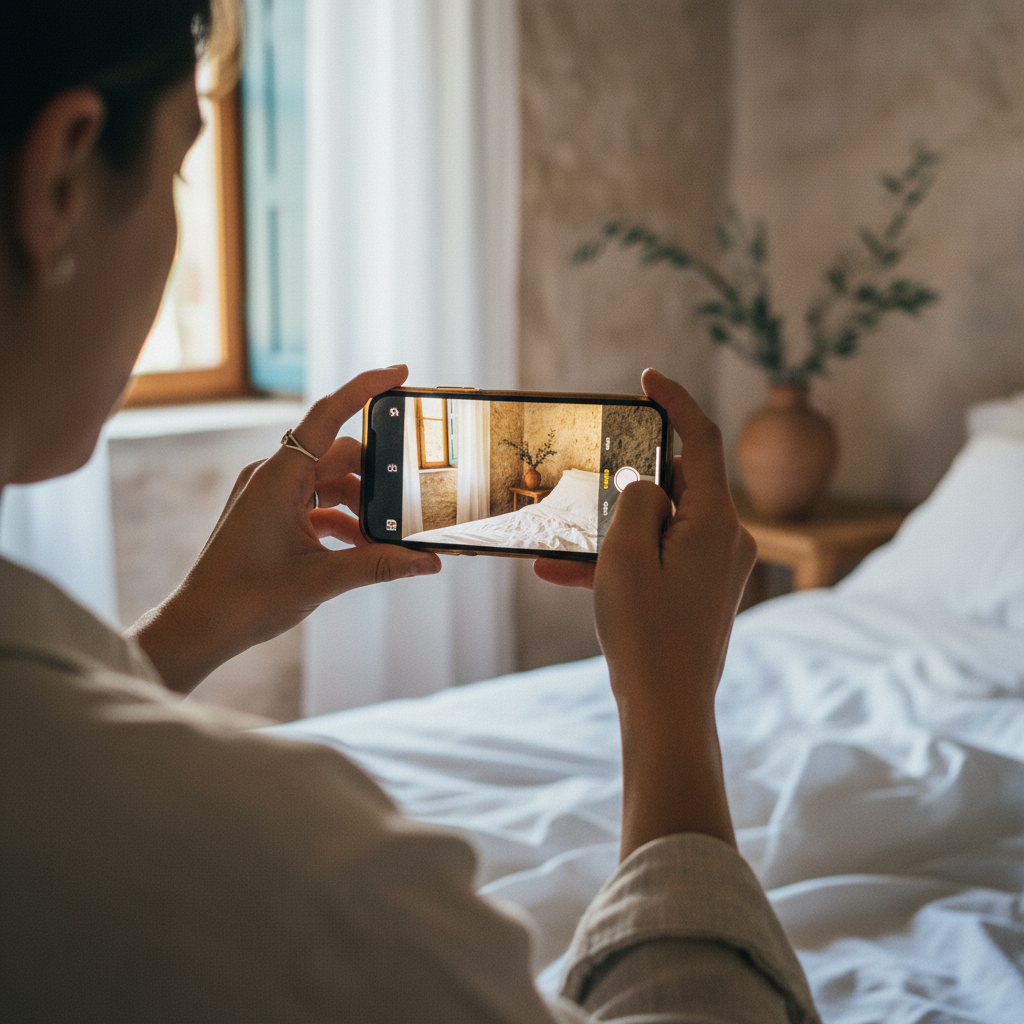
Smartphone Apartment Photography: A Guide to 20% More Bookings
BookiApp Tim
Vacation Rental Guest App
Key takeaway
High-quality photos are the most important marketing tool for vacation rental hosts, and they can be achieved with a modern smartphone. The key to success is shooting during the 'golden hour' (the hour after sunrise and before sunset) for soft, warm light. Use a low angle (around 1 meter high) and the rule of thirds for spaciousness and dynamism. Activate HDR and the grid on your camera, and use free tools like Lightroom Mobile to correct lines and adjust brightness.
Key points
- 1Golden Hour: Shooting within an hour of sunrise/sunset eliminates harsh shadows and creates a warm atmosphere.
- 2Low Angle: Photographing from waist height (100-120 cm) makes rooms look visually larger and more spacious.
- 3Free Tools: Adobe Lightroom Mobile and Snapseed offer powerful tools for correcting perspective and adjusting colors, for free.
- 4Rule of Thirds: Activate the 'grid' on your camera and position key elements at the intersections for better composition.
- 5Professional as an Investment: For complex spaces and luxury villas, an investment of €150-€400 in a photographer brings a significant return.
Table of contents
The quality of your photos on platforms like Booking.com and Airbnb directly impacts your clicks, booking rate, and final revenue. Research shows that listings with professional photos can generate up to 40% more income and 20% more bookings. The good news is that you don't always need expensive equipment to achieve professional results.
Modern smartphones have cameras with performance that, just a few years ago, was reserved for DSLR cameras. With the right technique, an understanding of light and composition, and the use of free editing tools, any host can significantly improve their property's visual identity.
This guide walks you through the key steps to creating photos that attract guests and increase occupancy, using only your smartphone.
— 01Timing Your Shoot: Why the 'Golden Hour' Is Crucial
The best time to photograph interiors and exteriors is during the 'golden hour,' which is the period within an hour after sunrise and an hour before sunset. During this time, the light is soft, diffused, and warm, eliminating the harsh shadows created by direct midday sun and creating a pleasant, inviting atmosphere that flatters any space.
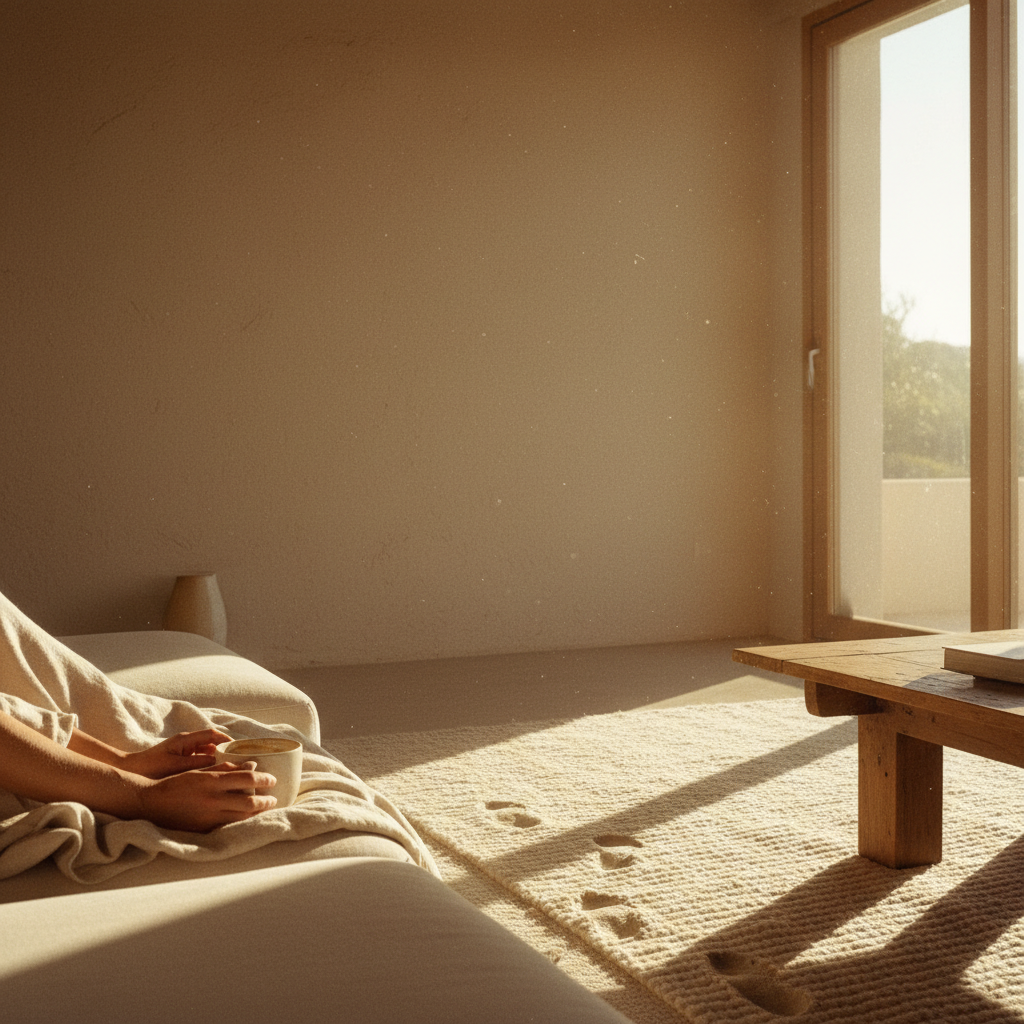
Shooting at noon, especially in destinations like Hvar or Brač, results in overly high contrasts. Windows are often overexposed (completely white), while the corners of the room are too dark. Photos taken during the golden hour require significantly less correction in post-production.
For precise planning, it's recommended to use sun-tracking apps or check the local weather forecast on sites like meteo.hr. Before you start shooting, turn on all the lights in the apartment, even during the day. Ambient lighting adds depth and warmth, making the space feel cozier.
20%
more clicks on the listing
90 seconds
average guest decision time
40%
potential for higher revenue
— 02Composition and Angles: Rules for Visually Appealing Photos
Proper composition and choice of shooting angle are key to creating photos that show the space realistically yet spaciously. The two basic rules that make the biggest difference are the rule of thirds and shooting from a low angle.
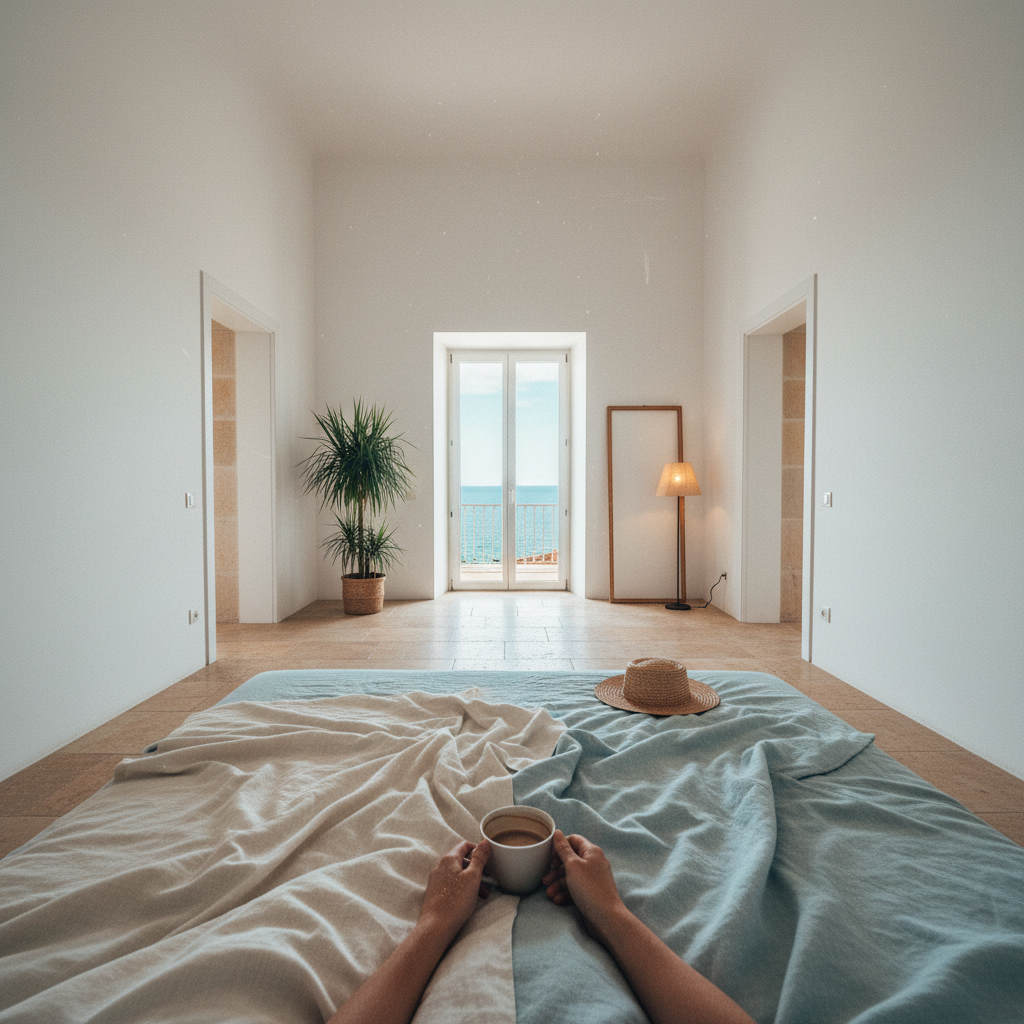
The Rule of Thirds is a fundamental principle in photography. Imagine your screen is divided by two horizontal and two vertical lines, creating a grid of nine equal rectangles. Position the most important elements of the scene (e.g., bed, sofa, window with a view) along these lines or at their intersections. This avoids a static, central composition and creates visual dynamism that guides the viewer's eye through the photograph.
A low shooting angle makes rooms appear larger. Instead of shooting from eye level (around 160-180 cm), lower your phone to waist or chest height (around 100-120 cm). Here are the most important reasons why:
- Reduces distortion: Shooting from a high angle distorts vertical lines (walls, doors), making them appear to collapse inward.
- Shows more space: A lower angle captures more of the furniture and floor, giving a sense of spaciousness.
- Professional look: This is standard practice in real estate photography.
Always try to shoot from the corner of a room to capture as much space as possible. Ideally, include two walls in the photo, and sometimes three, to create a sense of depth.
— 03Camera Settings 90% of Hosts Never Touch
The automatic mode on a smartphone camera is good, but a few simple manual settings can drastically improve photo quality. Most users never venture into the advanced options that are just a few taps away on the screen.
Key settings to activate:
- Grid: In your camera settings, enable the 'Grid' option. This will display lines on your screen to help you apply the rule of thirds and ensure your horizontal and vertical lines are straight.
- HDR (High Dynamic Range): Turn on HDR mode. This function takes several photos at different exposures and merges them into one, capturing details in both the brightest (e.g., a window) and darkest (e.g., a corner of the room) parts of the image. It's ideal for interiors.
- AE/AF Lock (Exposure/Focus Lock): Tap the part of the screen you want to focus on and hold your finger for a second or two. An 'AE/AF Lock' indicator will appear. This locks the focus and exposure, preventing the camera from automatically changing the brightness as you frame your shot. After locking, you can usually use a slider to further brighten or darken the image.
- Turn off the flash: The built-in flash on a smartphone creates harsh, unnatural light and strong shadows. Always keep it turned off and rely on natural and ambient light.
Your cover photo is the digital front door to your apartment. Guests decide whether to even click on your listing based on it.
— 04Photo Editing: Free Tools for a Professional Look
Even the best-shot photograph can benefit from minimal editing. The goal is not to create an unrealistic image but to correct minor flaws and emphasize the space's best attributes. Free, yet incredibly powerful, mobile tools are sufficient for this.
Adobe Lightroom Mobile is the industry standard, available in a free version that offers everything a host needs: - Light: Adjust Exposure (overall brightness), Contrast, Highlights, and Shadows. - Color: Adjust Temp (color temperature, for a warmer or cooler feel) and Vibrance (color intensity). - Geometry: The most important tool. Use the Upright option to automatically or manually correct the vertical lines of walls and furniture. Straight lines are a hallmark of professional photography.
Google Snapseed is another excellent free alternative: - Tune Image: Allows for basic adjustments of brightness, contrast, and saturation. - Perspective: Similar to Geometry in Lightroom, it allows for correcting distorted lines. - Selective: Allows you to brighten or darken only specific parts of the photograph.
The key is subtlety. The goal is for the photo to look bright, clean, and natural. Excessive editing and oversaturated colors can create distrust among guests and lead to poorer reviews if the actual space doesn't match the photos. Analyses from rental portals regularly emphasize the importance of authenticity.
— 05When Is a Professional Photographer a Better Investment?
While a DIY approach can yield excellent results, there are situations where hiring a professional photographer is a smart business decision. An investment of €150 to €400, depending on the location and size of the property, often pays for itself through an increased number of bookings within the first season.
Consider a professional if your property has any of the following characteristics:
- Complex layout: Small rooms, narrow hallways, or unusual angles that are difficult to capture without a wide-angle lens.
- Challenging lighting conditions: Spaces with little natural light or large glass walls that create high contrast.
- Luxury properties: Villas with pools near Pula or Dubrovnik where details and a premium feel are crucial to justifying a high price.
- High competition: In markets like Split or Rovinj, where hundreds of apartments compete for the same guest, top-tier photos are a necessity, not an option.
A professional photographer uses techniques like 'flambient' (a combination of flash and ambient light) and HDR bracketing to create perfectly lit and sharp photos that a smartphone simply cannot replicate.
BookiApp Data
An analysis of listings on the BookiApp platform shows that properties with more than 20 high-quality photos have a 15% lower cancellation rate because guests have clearer expectations.
Case Study: An Apartment in Trogir
A host of a 50m² apartment in the old town of Trogir was using old photos taken with a smartphone without applying these techniques. The images were dark, shot from a high angle, and had visible line distortion.
After applying the tips from this guide—shooting in the late afternoon, from a lower angle, with HDR activated, and with light editing in Lightroom Mobile—the new photos completely transformed the listing. The result was an 18% increase in inquiries and a 10-day increase in pre-season occupancy compared to the previous year, which directly increased revenue by approximately €1,200.
A time investment of a few hours yielded a measurable financial return, confirming that photos are one of the most powerful revenue management tools. According to data from the Ministry of Tourism and Sport, visual presentation is key to competitiveness in the Croatian market.
High-quality photos are no longer reserved for those with professional equipment. With knowledge of light, composition, and a few free tools, every host can dramatically improve their online presence. It's an investment that costs nothing but time and delivers a direct return through more bookings and more satisfied guests.
Sources
Frequently asked questions
1What is the ideal number of photos for a listing?
Ideally, you should have between 20 and 30 high-quality photos. This is enough to showcase all rooms (bedroom, kitchen, bathroom, balcony), key amenities, the building's exterior, and the immediate surroundings. Fewer than 15 photos can give the impression that you are hiding something.
2Should I use the wide-angle lens on my smartphone?
Use it with caution. While a wide-angle lens can make a space look larger, it often creates unrealistic distortion (a 'fisheye' effect) at the edges of the image. If you use it, make sure key furniture elements remain in the center of the frame where distortion is minimal. The main camera is the better choice in 90% of cases.
3Can I use vertical photos?
Avoid vertical photos for major platforms like Booking.com and Airbnb. Their interfaces are optimized for horizontal (landscape) photos. Vertical photos display poorly, leaving black bars on the sides, and look unprofessional. The vertical format is more suitable for Instagram Stories or Reels.
4Should I also photograph the area around the apartment?
Absolutely. Guests aren't just renting four walls; they're renting an entire experience. Include a few photos of the view from the balcony, the nearest beach, the street you're on, or a nearby restaurant or park. This helps guests visualize their stay and adds context to your location.
BookiApp Tim
Vacation Rental Guest App
The BookiApp Team combines hands-on hosting experience with market data insights. We write practical guides for small-scale hosts of apartments, villas, and rooms—no fluff, just actionable numbers and verified sources.
Related articles
Vacation Rental Insurance: What Airbnb and Booking Don't Cover (2026)
Think Airbnb AirCover or Booking.com's insurance has you covered? Discover what these platforms miss, from guest liability to property damage, and what policy you actually need.
Read more
How to Get Guests to Book Direct and Save 18% on Commissions
A guide for vacation rental hosts in Croatia: Learn how to legally encourage guests to book direct, avoid Booking.com's 15-18% commission, and build a loyal guest base.
Read more