

Handling a Drunk Guest in Your Vacation Rental: A 5-Step Protocol
BookiApp Tim
Guest Experience Software for Hosts
Key takeaway
A problematic, intoxicated guest poses a risk to your property and reputation. Prevention is key, with clear house rules banning parties and setting quiet hours. If an incident occurs, address it calmly the next morning. Escalate with an official warning via the platform, and only call the police for aggression or property damage. Save all communication and evidence (messages, photos) to report any potential retaliatory reviews.
Key points
- 1Prevention is key: Precise house rules that explicitly ban parties and state quiet hours reduce the risk of incidents by over 40%.
- 2Never argue with an intoxicated guest: Always have the first conversation the next morning when the guest is sober. Communication should be calm, private, and solution-focused.
- 3Documentation is everything: All communication must go through the official platform (Booking.com, Airbnb). Screenshots, photos of damage, and a police report are your strongest evidence.
- 4Police as a last resort: Only call the police for threats, aggression, property destruction, or a guest's refusal to leave after a reservation has been canceled.
- 5Write a factual review: When reviewing the guest, stick to the facts. State which rule was broken, when, and what the consequences were, without emotional commentary.
Table of contents
Dealing with an intoxicated guest is one of the most stressful scenarios in the vacation rental business. The situation carries the risk of property damage, strained relationships with neighbors, and, inevitably, a negative retaliatory review that can harm your business for months to come.
However, these incidents don't have to end in disaster. By establishing a clear, professional protocol, hosts can protect their property, maintain good relations in their building, and significantly increase their chances of removing an unfair review.
This guide provides a structured, five-step approach, from prevention to managing the aftermath, based on the practices of successful property managers in destinations like Split and Hvar, where such events are more common.
— 01Step 1: Prevention Through House Rules and Communication
The best way to solve a problem is to prevent it from happening in the first place. Precisely defined house rules are the foundation of prevention and your first line of defense. They set clear expectations before the guest arrives and serve as a legal basis for action if they are violated.
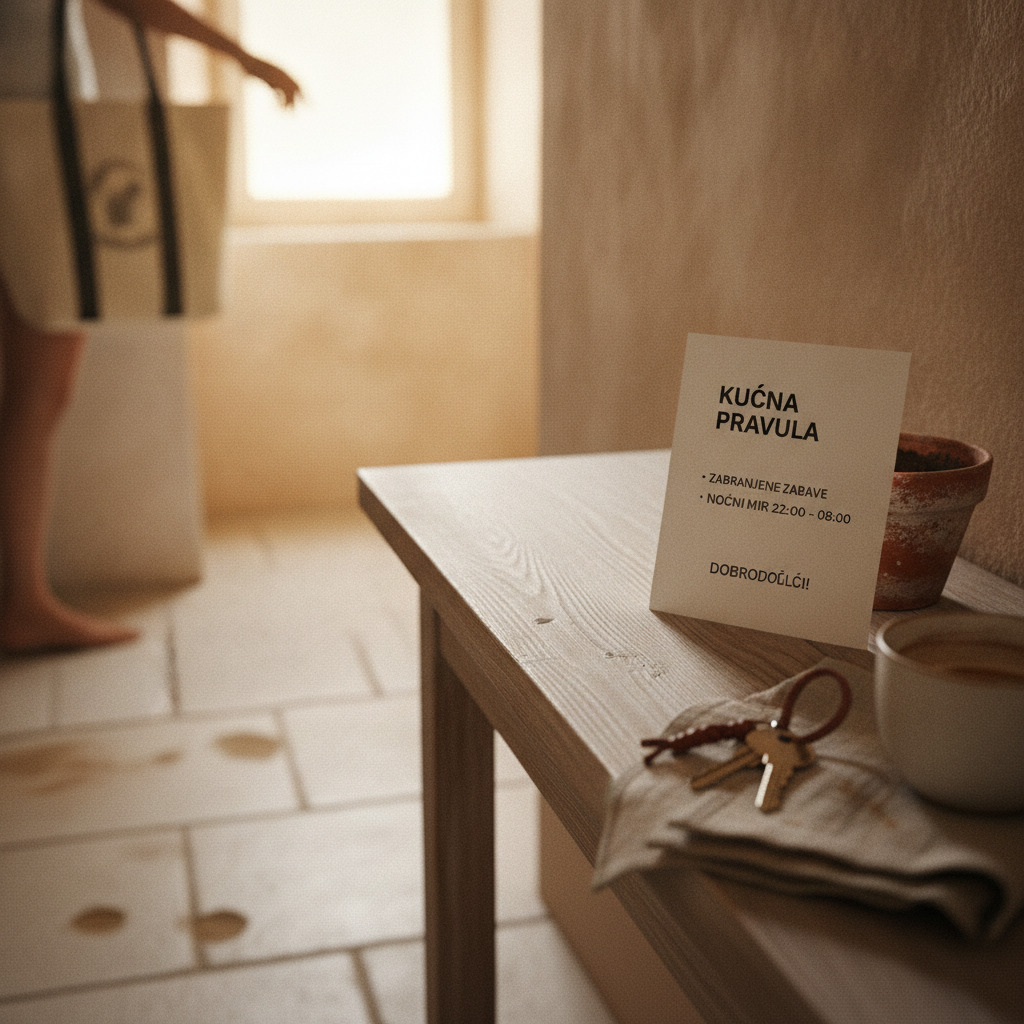
Your house rules, displayed on Booking.com or Airbnb, must include the following points:
- No Parties or Events: Explicitly state, "Parties, celebrations, and any gatherings exceeding the number of registered guests are strictly prohibited."
- Quiet Hours: Define the exact period in accordance with your local municipality's (grad or općina) 'Odluka o kućnom redu'. This is typically from 10:00 PM to 8:00 AM, but you must verify this with local regulations.
- Noise Policy: State that excessive noise will not be tolerated at any time of day.
- Consequences for Violations: Clearly communicate the consequences, such as retaining the security deposit or canceling the reservation without a refund.
In addition to your property profile, repeat the key points of your house rules in an automated welcome message. A message sent the day before arrival reminds the guest of the rules just as they are planning their stay.
BookiApp Data
An analysis of over 200 hosts in the BookiApp database shows that those who reiterate the rules about parties and quiet hours in their welcome message receive 30% fewer noise complaints from neighbors.
— 02Step 2: First Contact and De-escalation
When you receive a noise complaint or witness inappropriate behavior, it's crucial to react calmly and strategically. Never confront a guest while they are visibly under the influence of alcohol. Such a conversation is unproductive and can escalate.
The protocol for first contact is as follows:
- 1 Wait Until Morning: Address the guest the next day, ideally between 9:00 AM and 11:00 AM. Give them a chance to sober up and see the situation with some distance.
- 2 Communicate Privately: Ask the guest for a private conversation, away from the rest of their group or family. This reduces defensive behavior.
- 3 Use a "We" Approach: Instead of an accusatory tone ("You were too loud"), use a more inclusive approach: "We had a noise complaint last night, so I wanted to check if everything is okay and remind you of the quiet hours policy."
- 4 Reference the Rules: Remind them that they agreed to the house rules when booking. This keeps the conversation within the realm of a business relationship, not a personal conflict.
After the verbal conversation, send a brief message through the platform (Booking.com or Airbnb) summarizing your agreement. For example: "Dear {guest name}, thank you for our conversation this morning. This is just to confirm our agreement to respect the quiet hours from 10:00 PM to ensure a pleasant stay for everyone. Thank you for your understanding."
This message becomes written proof that you attempted to resolve the issue peacefully.
— 03Step 3: Escalation, Cancellation, and Calling the Police
If the guest ignores the first warning and continues their inappropriate behavior, it's time to escalate. At this stage, all communication must be in writing and conducted exclusively through the official platform for evidence.

A formal warning via the platform should be direct and clear:
"Dear {guest name}, despite our conversation this morning, we have again received complaints about excessive noise. This is a formal warning. Any further violation of the house rules will result in the cancellation of your reservation without a refund, in accordance with {Booking.com/Airbnb} policy."
When should you call the police? The police are not a service for resolving noise complaints but an institution that responds to violations of the law. A call is justified only in the following situations:
- Aggressive Behavior or Threats: If you feel threatened.
- Destruction of Property: If the guest is intentionally breaking items.
- Refusal to Leave the Property: If you have canceled the reservation and the guest refuses to leave.
- Suspicion of Illegal Activities.
According to the Croatian 'Zakon o prekršajima protiv javnog reda i mira' (Law on Offenses Against Public Order and Peace), depending on the classification of the offense, the police can issue fines in various ranges: for shouting and arguing, from 300 to 2000 EUR, and for particularly brazen and indecent behavior, fines range from 700 to 4000 EUR. When calling 192, be brief and clear: state the address, describe the situation (e.g., "a guest is destroying property"), and request intervention.
| Situation | Action | Call the Police? |
|---|---|---|
| Loud music after 10:00 PM | Warning via the platform | No, unless it's a repeat offense |
| Verbal argument with the guest | Attempt to de-escalate, written warning | No, unless it becomes a threat |
| Breaking a glass or plate | Document damage for the deposit | No, this is material damage |
| Threats or physical assault | Ensure your own safety | Yes, immediately |
| Refusal to leave after cancellation | Inform the guest they are trespassing | Yes, if they don't leave within a reasonable time |
— 04Step 4: Defending Against a Retaliatory Review
A retaliatory review is an almost certain outcome of such an incident. However, if you've followed the protocol, you have a strong chance of getting it removed. Platforms like Booking.com and Airbnb have policies against reviews that are used as blackmail or are not relevant to the stay.
To defend against such a review, it's crucial to collect evidence and contact platform support immediately. Your removal request must be based on evidence, not just your side of the story. Collect everything:
- Screenshots of Communication: Warning messages you sent via the platform.
- Photos or Videos: Any material damage.
- Witness Statements: An email or message from a neighbor who complained.
- Police Report: If the police intervened, request the intervention number or a copy of the report. This is the strongest possible evidence.
Once the guest leaves a review, report it immediately through your extranet or host dashboard. In the report description, state briefly and clearly: "This review is retaliatory. The guest's reservation was canceled for violating house rules (specify which, e.g., no-party policy and noise). We are providing the following evidence: A) correspondence with the guest, B) police report no. {report_number}."
WRITTEN PROOF
Crucial for successful review removal
INCIDENT REPORTING
Report as soon as possible; Airbnb allows 14 days from checkout to file a damage claim, but this window closes sooner if a new guest checks in.
POLICE REPORT
The strongest evidence you can provide
— 05Step 5: How to Write a Review for a Problematic Guest
The final step is to leave a review for the guest. The goal of this review is not revenge but to inform other hosts about a potential risk. The review must be objective, professional, and based solely on facts.
Stick to the following formula:
- 5 Start with a neutral fact: "{Guest Name} stayed at our apartment from {date} to {date}."
- 6 State the violation: "Unfortunately, during their stay, the guest did not respect the house rules regarding the no-party policy and quiet hours. Despite a verbal and written warning, the noise continued."
- 7 Describe the consequences: "The situation required intervention to maintain order in the building, and the reservation ultimately had to be canceled."
- 8 End with no recommendation (or a negative one): "For these reasons, we cannot recommend this guest to other hosts."
❌ Bad Example (Emotional): "The worst guest ever! He was drunk, rude, destroyed my apartment, and terrorized the whole building. Stay far away!"
✅ Good Example (Factual): "The guest violated house rules by hosting a party. After warnings were ineffective, we were forced to cancel the reservation. Minor property damage was also noted. We do not recommend."
A professional and documented approach turns a stressful incident from a personal offense into a solvable business problem.
Managing problematic guests is a test of professionalism. While you hope these situations never arise, having a predefined protocol ensures you are prepared to react effectively, protect your property, and preserve your long-term reputation on the platforms that generate most of your income.
Sources
Frequently asked questions
1What if the guest claims they never received the house rules?
House rules are part of the booking agreement on platforms like Booking.com and Airbnb. Additionally, by sending the rules in a welcome message, you create a written record that the guest was informed, which protects you from such excuses.
2Can I keep the security deposit because of noise?
A security deposit is primarily for covering material damages. Withholding a deposit for noise is only possible if your house rules explicitly state a financial penalty for violating quiet hours, a practice that platforms generally do not encourage.
3How quickly do Booking.com or Airbnb respond to a review report?
Response times vary. If you provide strong evidence like a police report, a decision may be made within 48-72 hours. In more complex cases without clear evidence, the process can take up to a week.
4Should I talk to my neighbors after the incident?
Yes, it's highly recommended. A brief apology to your neighbors the day after the incident shows you are a responsible host and helps maintain good relationships. Explain that you handled the situation according to your rules and thank them for their patience.
BookiApp Tim
Guest Experience Software for Hosts
The BookiApp Team combines the experience of active hosts with analytical market insights. We write practical guides for small-scale apartment, villa, and room rentals—no fluff, just concrete numbers and verified sources.
Related articles

Vacation Rental Insurance: What Airbnb and Booking Don't Cover (2026)
Think Airbnb AirCover or Booking.com's insurance has you covered? Discover what these platforms miss, from guest liability to property damage, and what policy you actually need.
Read more
How to Get Guests to Book Direct and Save 18% on Commissions
A guide for vacation rental hosts in Croatia: Learn how to legally encourage guests to book direct, avoid Booking.com's 15-18% commission, and build a loyal guest base.
Read more